Editor’s Note: This piece was developed using AI-assisted research and drafting to ensure data precision and speed. It has been reviewed, edited, and fact-checked by Wolf Bishop to ensure it meets our standards for strategic depth and lived experience.
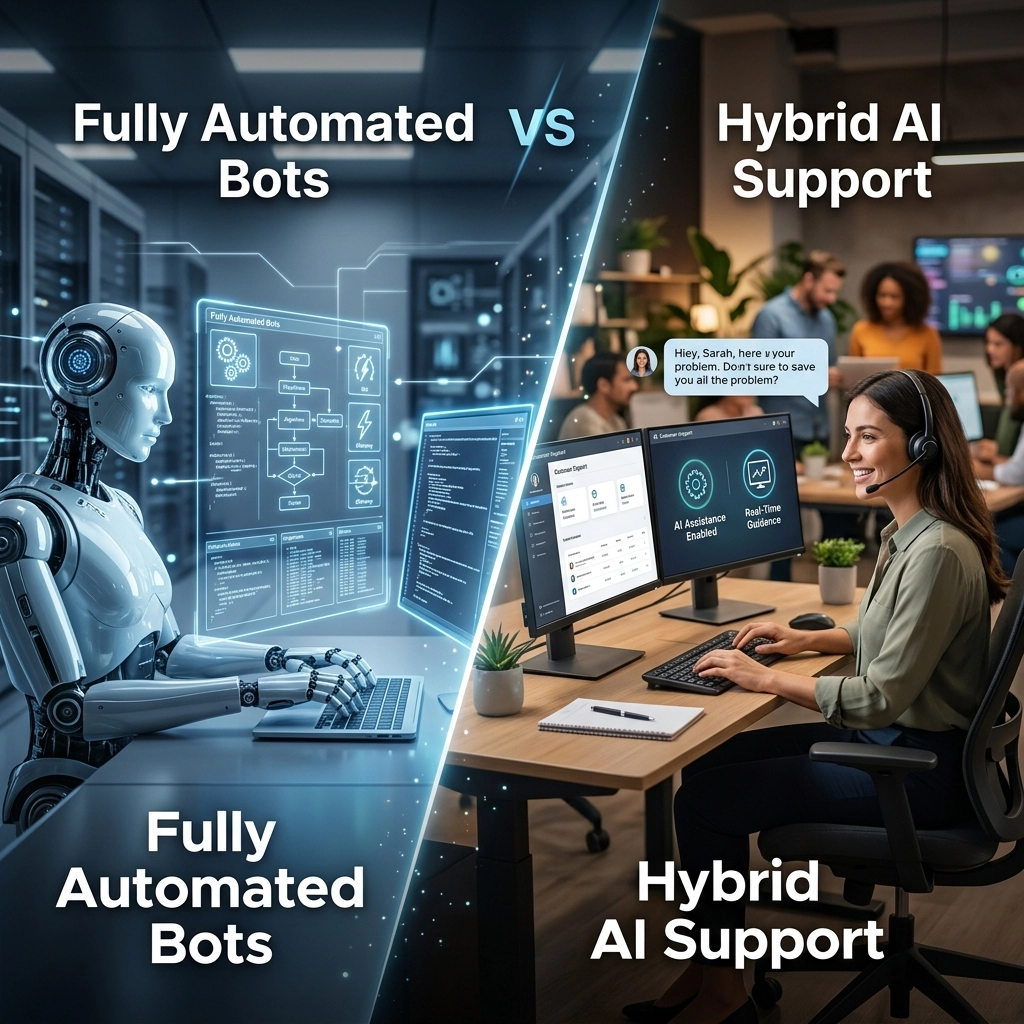
In the race to maximize efficiency and slash overhead, many brands are standing at a digital crossroads: Do you hand the keys of your customer experience entirely to an autonomous agent, or do you maintain a "human-in-the-loop" system? While the allure of a 100% automated helpdesk is strong, the data suggests that your brand's reputation, the very foundation of your business, is at stake if you choose the wrong path.
Key Takeaways
- Hybrid AI support consistently outperforms fully autonomous systems by a margin of nearly 69% in resolution success.
- Autonomous agents have failure rates 32-49% higher than human-assisted workflows, often leading to "hallucinations" or false data delivery.
- Customer Satisfaction (CSAT) is tied to empathy and nuance, areas where full automation currently struggles.
- Hybrid models allow you to "deflect" routine tickets without abandoning high-stakes, high-emotion interactions.
The Reputation Crisis: Why "Set It and Forget It" Fails
Many entrepreneurs view AI as a replacement for labor. This is a strategic error. When you fully automate your support without a safety net, you aren't just saving money; you are gambling with customer trust.
Consider the recent case of Klarna, the fintech giant. After aggressively pivoting to AI chatbots and reducing their workforce, the results were a mixed bag. While efficiency metrics looked good on paper, customer dissatisfaction climbed by 35%, and resolution times actually increased by 27%. The CEO eventually conceded that quality human support remains the future of the brand.
When an AI agent fails, it doesn't just say "I don't know." It often provides "plausible but false" information, a phenomenon known as hallucination. If a bot gives a customer the wrong refund policy or technical advice, the damage to your brand’s credibility is immediate and often permanent.
The Hybrid AI Support Advantage: The Strategic "Co-Pilot"
A hybrid approach utilizes AI support as a high-speed filter rather than a total replacement. The goal is to automate the mundane and escalate the meaningful.
1. Superior Quality Control
Hybrid systems use Natural Language Understanding (NLU) to categorize incoming queries. If the AI detects a high-confidence match (e.g., "Where is my order?"), it provides an instant response. If it detects frustration or a complex technical issue, it initiates a human handoff.
2. Context-Aware Personalization
Fully automated bots often treat every customer like a fresh ticket. A hybrid model ensures that when a human steps in, they have the full transcript of the AI’s interaction. This prevents the #1 customer complaint: having to repeat themselves.
3. Maintaining the Brand Voice
AI can be trained on your brand's tone, but it lacks the "moral compass" and emotional intelligence to handle sensitive escalations. Hybrid AI allows your team to step in during high-emotion moments to provide empathy that a bot simply cannot simulate.

Phase-Based Roadmap for Reputation-First Automation
To protect your brand, you cannot flip a switch to "Full Auto" overnight. You must move through a structured deployment.
Phase 1: The Deflection Audit (Days 1–30)
Start small. Identify the top 10 most frequent, low-stakes questions in your helpdesk.
- Action: Program your chatbot to handle only these specific intents.
- Metric: Track the "Deflection Rate." If the bot handles 40% of queries successfully, you've already freed up massive human capacity without risking reputation on complex cases.
Phase 2: Integrated Knowledge Retrieval (Days 31–60)
Implement Retrieval-Augmented Generation (RAG). This allows your AI to pull answers directly from your official documentation rather than "guessing."
- Action: Connect your AI to your internal knowledge base.
- Metric: Monitor the "Accuracy Rate." Have your team review 10% of AI responses daily to ensure no false information is being leaked.
Phase 3: The Seamless Handoff (Days 61–90)
This is where the hybrid model truly shines.
- Action: Set up "Triggers" based on sentiment analysis. If a customer uses words like "angry," "unacceptable," or "sue," the bot should immediately stop and alert a human agent.
- Metric: Measure the "Hand-off Success Rate." How quickly does a human pick up where the bot left off?
Common Pitfalls: Why Reputation Crumbles
- The "Dead-End" Bot: Nothing ruins a reputation faster than a bot that says "I can't help with that" without offering a human alternative. Always provide a path to a real person.
- Hidden Costs of Debugging: Research shows that full automation can actually slow down a team by 17.7% because humans have to spend all their time "cleaning up" AI mistakes.
- Ignoring the Feedback Loop: If you don't use customer feedback to tune your AI's NLU models, the bot will continue making the same mistakes, frustrating your loyal small business clients.

The Math of Reputation: ROI vs. CSAT
When calculating your return on investment, don't just look at cost-per-ticket. Use this formula to gauge the health of your support system:
Reputation Health Score = (CSAT % + Retention Rate %) / (Resolution Time / 10)
A fully automated bot might lower your "Resolution Time," but if your CSAT (Customer Satisfaction Score) drops significantly, your Reputation Health Score will tank. Hybrid models typically maintain high CSAT while significantly lowering resolution time, leading to a much healthier overall brand.
Implementation Checklist for Brand Safety
Before you scale your AI support, ensure you can check off every item on this list:
- Transparency Disclosure: Does the bot identify itself as an AI? (Customers hate being tricked).
- Instant Escalation: Is there a "Talk to a Human" button visible at all times?
- Knowledge Base Sync: Is the AI pulling from the same documentation your human team uses?
- Sentiment Analysis: Can your bot detect when a customer is getting frustrated?
- Data Privacy: Does your automation tool comply with GDPR/CCPA to protect your users?
- Tiered Pricing Check: Have you reviewed your pricing-2 to ensure you have the capacity for human-handoff during peak hours?
Frequently Asked Questions
Is fully automated AI support cheaper than hybrid?
In the short term, yes, because you have zero labor costs. However, in the long term, the cost of customer churn (losing customers due to poor service) and the cost of "cleaning up" AI errors often make full automation more expensive than a well-oiled hybrid system.
Can AI eventually handle 100% of my support?
For very simple e-commerce brands with standard "Where is my order?" queries, you can get close to 90%. However, for any brand that values its reputation and deals with high-complexity or high-emotion products, a human presence is essential for the final 10-20% of interactions.
How do I start with hybrid AI?
Start by integrating an AI tool like Reply Botz into your existing helpdesk. Use the AI to draft responses for your humans first. Once the drafts are 95% accurate, you can let the AI send them directly for simple queries.
What is the biggest risk to my brand's reputation with AI?
Hallucinations. When an AI confidently provides incorrect information, it breaks the "Contract of Trust" between you and your customer. Hybrid models mitigate this by having humans "spot-check" and supervise the AI’s output.
If you're ready to build a support system that scales without sacrificing your brand's soul, contact us today. We specialize in building the hybrid bridge between cutting-edge AI and the human touch your customers deserve.