
For years, the promise of "automated customer service" was a hollow one. We were promised high-tech assistants but given rigid, decision-tree chatbots that could barely handle a password reset, let alone a multi-step financial transaction like a refund. If you’ve ever felt the frustration of a bot looping you back to the main menu when you asked for your money back, you know the gap between hype and reality.
However, a fundamental shift is occurring in the industry. We are moving from Conversational AI (bots that talk) to Agentic AI (agents that do).
Agentic AI doesn't just answer questions about your refund policy; it integrates with your tech stack, verifies the order, checks the return window, calculates the restocking fee, and initiates the transfer in your payment processor. It is the transition from a "chat interface" to a "digital employee."
Key Takeaways
- Definition of Autonomy: Agentic AI is defined by its ability to use tools (APIs) and make multi-step decisions without constant human prompting.
- Operational Efficiency: Implementing agentic workflows can reduce manual refund processing time by up to 90%, significantly lowering operational overhead.
- Trust Through Logic: By utilizing Retrieval-Augmented Generation (RAG) and Function Calling, these agents ensure 100% compliance with your brand’s specific policies.
- Scalability: Small businesses can now handle enterprise-level ticket volumes without increasing headcount by automating high-frequency, high-complexity tasks.
The Anatomy of an Agentic Refund Workflow
To understand why agentic AI is different, we must look at the technical architecture of a "doer" versus a "talker." A traditional bot is reactive; an agentic system is proactive and goal-oriented.
When a customer asks for a refund, the agentic system follows a sophisticated, multi-stage logic path:
1. Intent Triage and Policy Retrieval
The system uses Natural Language Understanding (NLU) to identify the request. It then queries your internal knowledge base: using RAG technology: to pull the exact refund policy applicable to that specific product or customer tier.
2. Cross-System Verification
This is where "Agentic" behavior shines. The AI isn't just looking at the chat; it is looking at your Shopify, Stripe, or Zendesk logs. It verifies:
- Was the item delivered?
- Is it within the 30-day window?
- Has this customer exceeded a "high-risk" refund threshold?
3. Execution via Tool-Calling
Once the criteria are met, the agent uses Function Calling to trigger an action in an external system. It communicates with your payment gateway to issue the credit and updates your CRM, all while keeping the customer informed in real-time.

Why "Conversational" is No Longer Enough
In the current market, simply being able to converse is a commodity. For small and medium-sized businesses, the goal isn't just to talk to customers: it’s to solve their problems so you can focus on growth.
Traditional Chatbots rely on static scripts. If a customer deviates from the script, the bot fails. This leads to poor Customer Satisfaction (CSAT) scores and increased churn.
Agentic AI Systems utilize reasoning. If a customer says, "I want a refund because the box was crushed, but I still want the item," an agentic system recognizes this as a Damage Claim, not a standard return. It can then pivot the workflow to offer a partial discount or a replacement, rather than a full refund, protecting your revenue while satisfying the customer.
Pro Tip: Prioritize high-impact, repetitive cases. Refunds, order tracking, and subscription cancellations are the "low-hanging fruit" where agentic AI provides the highest Return on Investment (ROI).
Measuring the ROI of Automation
Before deploying agentic systems, you must establish a baseline for success. Use the following formula to calculate the potential savings of automating your refund process:
Monthly Savings = (N x T x R) – C
- N: Number of refund requests per month.
- T: Average time spent by a human agent per request (in hours).
- R: Hourly rate of the support agent.
- C: Monthly cost of the AI platform.
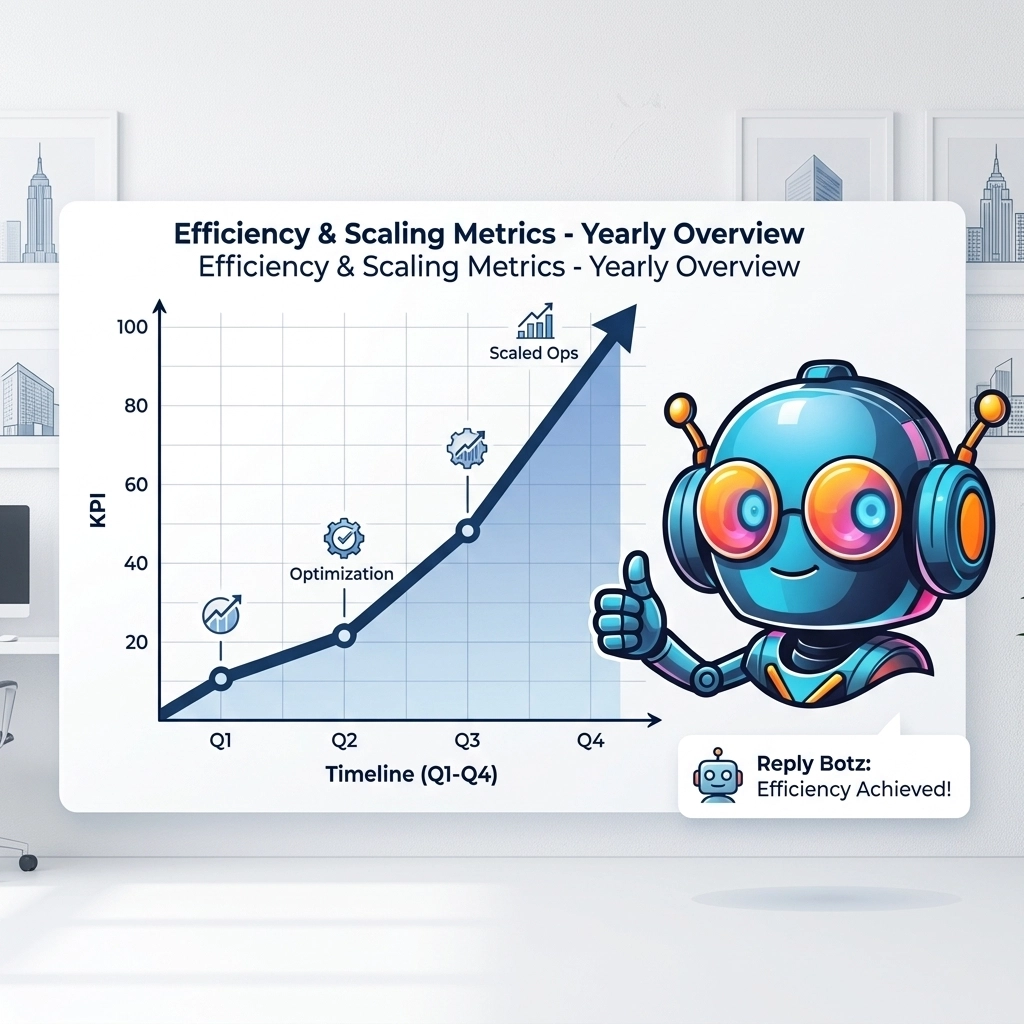
For most Reply Botz clients, we see a 70%+ reduction in staff workload within the first 90 days. This allows teams to shift from "transactional support" to "proactive customer success."
A 3-Phase Implementation Roadmap
Transitioning to an agentic model requires a structured approach. Do not attempt to automate every complex workflow on Day 1.
Phase 1: The "Observation" Layer (Days 1–30)
Deploy your AI agent in a "Read-Only" mode. Let it handle FAQs and gather data. Use this period to identify the most common refund reasons and edge cases. Ensure your documentation is up to date so the AI has a reliable source of truth.
Phase 2: The "Shadow" Layer (Days 31–60)
Allow the AI to draft responses and "suggest" actions to human agents. This is the Human-in-the-Loop phase. Your team reviews the AI’s logic for refunds and clicks "Approve" before the action is taken. This builds trust in the system's decision-making capabilities.
Phase 3: Full Autonomy (Days 61+)
Set threshold limits. For example, allow the AI to automatically process refunds under $50 if all policy checks are met. Anything above that amount: or any "High Risk" flagged accounts: is automatically escalated to a human manager.
Risk Management: Busting the "Bot Gone Wild" Myth
The biggest fear business owners have is an AI agent "going rogue" and emptying the company bank account through unauthorized refunds. This is a myth fueled by poorly configured systems, not the technology itself.
Effective Risk Management includes:
- Strict API Scoping: Only give the AI access to the specific functions it needs. It should be able to "Issue Refund," not "Change Bank Details."
- Rate Limiting: Cap the total dollar amount an AI can refund in a 24-hour period.
- Fraud Detection: Integrate with tools that flag suspicious patterns, such as a customer requesting five refunds in two days.

Common Pitfalls to Avoid
- Garbage In, Garbage Out: If your internal refund policy is vague or contradictory, the AI will be too. Standardize your SOPs (Standard Operating Procedures) before training the agent.
- Over-Automation: Some situations: like a high-value client who is genuinely upset: require a human touch. Ensure your AI + Human Helpdesk has a seamless handoff mechanism.
- Ignoring the Data: Agentic AI generates massive amounts of data about why customers are returning items. Use these insights to improve your product or marketing.
Implementation Checklist
- Audit your current workflow: How many steps does a refund currently take?
- Centralize your data: Is your refund policy documented in a format the AI can read (PDF, Doc, or Webpage)?
- Define your "North Star" Metric: Is it faster resolution time, or lower support costs?
- Select your tools: Ensure your AI platform integrates with your specific CRM and Payment Gateway.
- Start Small: Choose one product line or one type of refund to automate first.

FAQ
Q: Can the AI handle partial refunds?
A: Yes. Modern agentic systems can calculate partial amounts based on item condition, shipping costs, or restocking fees, provided those rules are clearly defined in your policy.
Q: What happens if the AI makes a mistake?
A: Like any employee, an AI needs clear boundaries. By implementing the "Shadow Layer" in Phase 2, you catch 99% of logic errors before they ever reach a customer. Furthermore, every action taken by an AI agent is logged and reversible.
Q: How do customers feel about "Bot" refunds?
A: Paradoxically, customers often prefer them. The #1 priority for a customer seeking a refund is speed. An AI that grants a legitimate refund in 30 seconds creates more loyalty than a human agent who takes three days to reply. We discuss the importance of transparency in our article on The Bot Disclosure.
If you are ready to stop answering the same questions and start scaling your business with practical AI, it’s time to look beyond the chatbot. Contact us today to see how an agentic helpdesk can transform your operations.
Editor’s Note: This piece was developed using AI-assisted research and drafting to ensure data precision and speed. It has been reviewed, edited, and fact-checked by Wolf Bishop to ensure it meets our standards for strategic depth and lived experience.