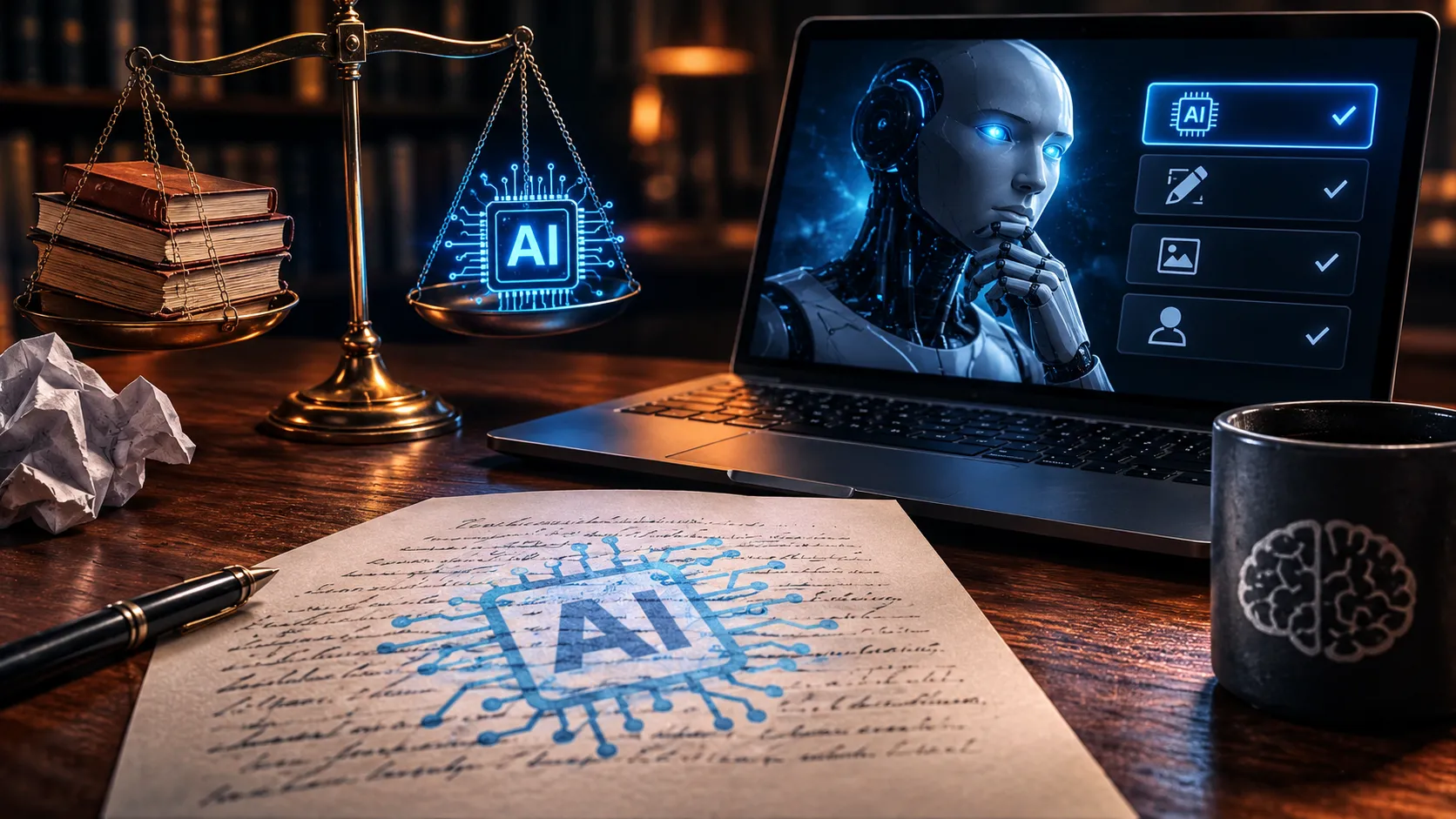
I canceled my Claude subscription today because of Anthropic's new AI watermarking system.
That probably sounds strange considering I actually support AI watermarking.
I think genuinely AI-generated content should be identifiable as such. As AI becomes capable of producing increasingly convincing writing, images, audio, video and software, provenance is going to become more important, not less.
I don't have a problem with transparency.
I have a problem with what that transparency actually tells us.
And after reading Anthropic's own explanation of its new system, I don't think the distinction is good enough yet.
I'm deliberately basing this argument on Anthropic's own documentation rather than news coverage or someone's interpretation of it.
You can read their explanation here:
https://www.anthropic.com/news/claude-text-watermark
Anthropic acknowledges the fundamental problem
Anthropic describes the limitation remarkably clearly.
According to Anthropic:
"A watermark can only determine that Claude was likely involved with the content at some point."
They then make an even more important distinction:
"It cannot distinguish 'Claude wrote this' from 'Claude heavily edited this.'"
That's my problem with the system in two sentences.
AI authorship and AI assistance are not the same thing.
Suppose I ask Claude:
"Write a 1,500-word article about AI watermarking."
Claude writes it.
Identifying Claude's involvement makes perfect sense.
Now imagine I spend three hours researching and writing that same article myself. Then I give it to Claude and ask it to substantially improve the organization, tighten some paragraphs and make the argument clearer.
I created the ideas.
I performed the research.
I wrote the original article.
Claude served as an editor.
Those are fundamentally different workflows.
Yet Anthropic acknowledges that its watermark cannot tell someone which one happened.
There's an important nuance here
I want to be precise because there's already some misleading discussion about how this technology works.
Simply showing Claude something does not magically watermark the original content.
Anthropic's text watermark works through the words Claude chooses when generating text.
That means light proofreading may leave very little detectable watermarking because Claude may change only a handful of words. Anthropic explicitly acknowledges this.
The more Claude writes or rewrites, however, the more opportunity there is for a detectable watermark. And where is that threshold? 5%? 10%? 50%?
Translation is an especially interesting example.
Anthropic says translations produced by Claude are watermarked because Claude chooses every word of the translation.
That's technically logical.
But consider what the watermark actually tells us.
The original ideas might be entirely mine. I might have written every word of the original document myself. Claude simply translated my work into another language.
The resulting watermark establishes Claude's involvement.
It does not establish Claude's authorship.
Anthropic acknowledges this distinction.
Code is another interesting case
Code is somewhat different.
Anthropic says code generally receives less watermarking because programming often requires exact tokens. When there's only one correct choice, the watermarking technique has nothing useful to manipulate.
Where arbitrary choices exist, including some comments and other areas of code, watermarking can occur.
So the claim that simply having Claude Code audit your software automatically watermarks your original source code would be wrong.
But if Claude generates or substantially revises portions of that code, its generated output may contain watermarking where the technique can operate.
Again, context matters.
"Claude was involved with this software" doesn't tell us who actually built it.
Images and files use a different system
Anthropic handles supported files differently.
When Claude produces supported files such as PNG, JPG or SVG files, Anthropic says it attaches cryptographically signed C2PA provenance metadata.
This isn't the same thing as the statistical watermark embedded in text.
The credential says the file was "made or processed with Claude."
That distinction matters.
Imagine I take a photograph myself.
It's unquestionably my photograph.
I then use Claude to process or modify it.
The resulting file can carry provenance indicating that Claude processed it.
Technically, that's accurate.
But once again, what will the person receiving that information conclude?
"Claude processed this image"?
Or:
"This is an AI-generated image"?
Those are very different statements.
The technology isn't necessarily making the false accusation
This is where I think the discussion needs more nuance.
Anthropic explicitly says its watermark doesn't determine ownership or authorship.
So I don't think it's accurate to simply accuse Anthropic of falsely labeling human work as AI-generated.
The bigger problem is downstream interpretation.
Imagine a student writes an assignment themselves and uses Claude to substantially improve the writing.
An author uses Claude to edit a manuscript.
A developer uses Claude to revise portions of their own software.
A marketer uses Claude to improve advertising copy they wrote.
A podcaster uses Claude to tighten a script.
A freelancer uses Claude as an editor before delivering work to a client.
Now imagine a detection system identifies Claude's involvement.
What happens next?
A professor could interpret that as evidence that AI wrote the assignment.
A client could conclude the freelancer didn't actually create the work.
A publisher could question authorship.
An employer could question an employee's work.
An automated platform could reject it before a human ever looks at it.
In every one of those cases, the detector might technically be correct.
Claude WAS involved.
The conclusion drawn from that information could still be completely wrong.
Is that censorship?
This is where I initially used the word "censorship," and I think it requires some qualification.
Is Anthropic censoring people simply by watermarking Claude's output?
No.
That's too broad.
But could this eventually contribute to a form of de facto censorship or create a chilling effect?
I think that's a legitimate question.
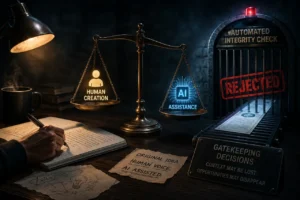
If schools, employers, publishers, clients or platforms eventually use AI provenance signals as gatekeepers, human-created work could potentially be rejected or suppressed because AI assisted with it.
The technology might say:
"Claude was involved."
The institution interprets that as:
"AI created this."
And the work gets rejected.
That's the scenario that concerns me.
I'm not claiming it's Anthropic's intention.
I'm saying it's a foreseeable downstream consequence worth addressing before these systems become widely used to make decisions about people's work.
I'm not opposed to what Anthropic is trying to accomplish
Anthropic isn't implementing this for no reason.
The company says it is implementing watermarking to comply with the EU AI Act and the Code of Practice on Transparency of AI-Generated Content.
Anthropic also says it's applying the system globally because it doesn't currently have a durable way to restrict watermarking geographically.
And the underlying goal makes sense.
We need better ways of determining where digital content comes from.
I support that goal.
But provenance needs context.
What I would rather see
I'm not going to pretend there's an easy technical solution.
It would be convenient to say:
"Just tell us what percentage was generated by AI."
But I haven't seen evidence that Anthropic's current watermarking technology can reliably determine something like that.
So I'm not going to demand a technically questionable solution just because it sounds good.
What I do think we need is enough provenance information to meaningfully distinguish different kinds of AI involvement.
AI-generated.
AI-edited.
AI-translated.
AI-assisted.
Human-created content processed using AI tools.
Maybe those aren't the eventual categories. The engineers working on provenance standards will understand the technical possibilities better than I do.
But I think the goal should be clear:
"AI was involved somehow" should not become synonymous with "AI created this."
Why I canceled and a call to action
Anthropic says its watermark detection API isn't even publicly available yet.
It's coming "soon," and the company says it is still working out implementation details.
That actually gives me some optimism.
This isn't necessarily a finished system.
There's still an opportunity to improve how these signals are communicated and interpreted.
But for now, I've canceled my Claude subscription.
Not because I'm trying to hide AI usage.
Not because I oppose watermarking.
And certainly not because I think people should be able to pass completely AI-generated work off as their own.
I canceled because I think AI provenance needs to become more precise before we normalize using it as evidence about authorship.
If you are a paying Claude user and you share these concerns, I would seriously consider pausing or canceling your subscription as well until Anthropic gets this distinction right. Not as a rejection of the idea of watermarking, but as a way of sending a clear signal that "AI was involved" is not a sufficient level of clarity when real consequences are attached to that label. Companies respond to user behavior, and right now the only way to communicate the importance of nuance is through that behavior.
I'll happily reconsider if Anthropic gets there.
Transparency is good.
But there's a pretty important difference between:
"AI created this."
and:
"AI was involved with this."
As I said earlier, Anthropic's own documentation says its watermark can't distinguish between the two.
I think we should take that limitation seriously.
AI Disclosure
And for the record, yes, I used Claude to heavily edit this article, but I did the research. The idea, thoughts, and opinions are my own. Claude helped me get my thoughts "on paper" in a clear, readable, and understandable way.
The images used however are 100% AI generated and then reformatted for the web manually by me.
Primary source
Anthropic, "How Claude's text watermark works," August 14, 2026: